
The novel Iosis, written by our composer, Adrien Djouadou, expands the world of HARTLIGHT’s third album of the same name. Discover the prologue and first chapter here, and help us bring the complete novel to life through our crowdfunding campaign.
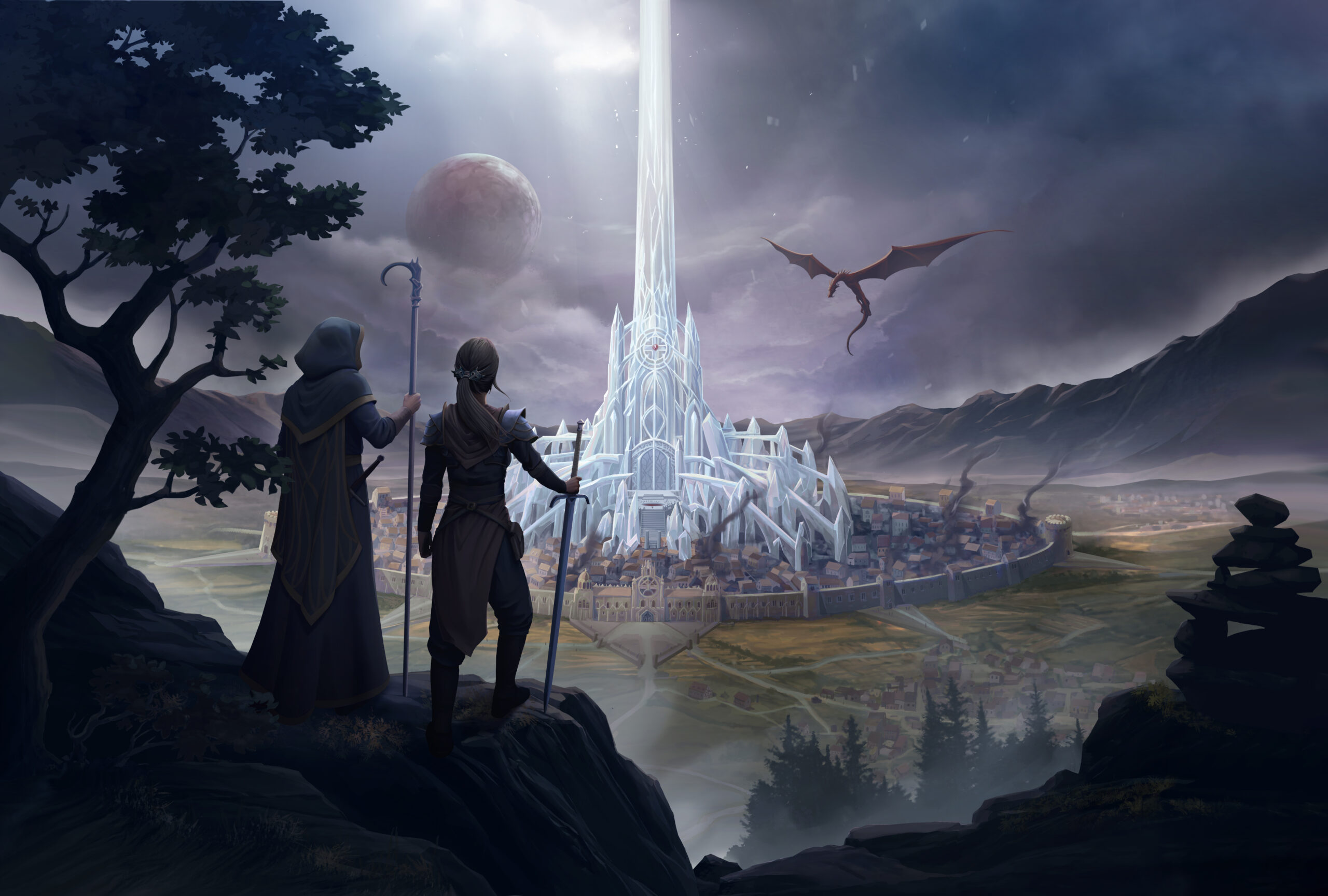
IOSIS – The Novel
PROLOGUE
Thus was Iosis in the beginning: a closed world, girded by a firmament of crystal, suspended amid the void. None knows whence its matter came nor who first shaped it. Yet the engraved tablets of the Ancients, which we call « Chronicles of Stone » and whose mysteries the wisdom of our Most Holy Cardinal alone can decipher, relate that the sky was raised like an impenetrable vault and that the earth, flat and vast, was stretched out beneath it, at the epicentre of the cosmos.
The Ancients, whose faces and language we no longer know, left within the eternal rocks the fragments of their memory. Through them, we know the course of the celestial bodies and the names of the two moons that preside over our nights and our days: Albedo the bright, who dances around the disc, and Darga the motionless, the blood-red, whose fixed eye weighs upon the hearts of mortals. Through them, too, we know that the lofty Tower rising at the centre of the world is the pillar of the sky and the axis of time, and that, without it, all would collapse into chaos.
Now, at the foot of this Tower, since the dawn of ages, rises the Crystal City. None remembers the time when its walls did not shine. Like a corolla born of light itself, it has always shone resplendent amid the plains, immutable, incorruptible, and its translucent ramparts reflect the celestial bodies as though the heavens came there to gaze upon themselves. Whoever approaches its gates knows that he treads the holiest ground in Iosis, for there the earth touches the divine.
It is in this place, in the heart of Caelumbria, the undisputed crowning glory of Men, that the Crystal Cross revealed itself to the faithful. An ancient mystery, a supreme gift crowning the gate of the Tower, it was held aloft as a sign and as a beacon: it illuminates the righteous, guides the peoples, protects the cities. From its light was born the unity of the kingdoms, from its radiance came forth the law, and from its glory arose the Cult which, for centuries, has preserved the world from madness and oblivion.
No sanctuary is its equal, no altar comparable to it: the Cross shines at the centre, and around it revolves all that breathes. It is the fixed star, the judge and the rampart, and those who serve it, by blood and by faith, see to it that corruption never crosses its sacred walls.
The gate of the Tower, closed since time immemorial, shall one day open unto us if we prove worthy of it and if, when the time comes, our souls are pure enough to rise beyond the sky. Woe to those who, through wickedness, blaspheme the precepts of the faith, for their souls shall be damned in the depths of the Pit.
Thus was the Cross established, as I have so wisely said, as centre and as law, and, to guarantee its authority, the Twelve were instituted. Their charge is not to dream nor to meditate, but to enforce the will of the Crystal throughout all the provinces of men. As light has strength only when it asserts itself, it falls to the priests to spread it like a flame that no wind could extinguish.
The Twelve are the electors of the Most Holy Cardinals, and, from within their circle, or else from among the Most Holy Executioners, is chosen the one who must bear the mitre and speak in the name of the Cross. Through them the spiritual throne remains ever occupied, and the order of the Cult never falters.
But the law alone does not suffice; the sword is also needed: and so the Most Holy Executioners are the arm of the Twelve. Where authority weakens, they march; where corruption rises, they strike. Their name is a shadow before which rebellious brows bend; their iron, a justice that none contests; their might, our rampart against the putrid creatures the Pit sends us as a divine trial.
As for the vast and fertile lands that extend beyond Caelumbria, they are entrusted to lords chosen by the Assembly. These lords swear an oath to the Cross, and their power, held of the Cult, can never cast off its yoke. Thus the sword of the nobles and the voice of the priests walk together, and, through this alliance, the world remains stable.
For such is perfect harmony: at the centre, the Tower and the Cross; around them, the resplendent City; and farther still, the lands governed by lords of faith. From one to the other flows the light, and nothing escapes it, not even shadow.
Archivald held his quill still for a moment. The ink was still spreading, glistening, across the page. He reread his own words, found them satisfactory, then smiled, dry creases scoring the corners of his mouth. That was enough for today: a solemn introduction, rich enough to instruct the ignorant, obscure enough that none would venture beyond what ought to be said.
His cell was narrow, austere, yet everything within breathed order and dignity. In one corner was a lectern, polished by the cycles, bearing sacred writings; at the centre stood an oaken table. Before it was the sole chair upon which he sat and, at his side, a torch whose flame wavered in the half-light. The bare stone walls cast back the flame’s glow, which traced upon them an abstract and shifting fresco. Behind his shoulder, a stained-glass window depicting the Cross cast bluish reflections into the room, staining his sacerdotal robe. The priest congratulated himself upon the chosen poverty the place exuded.
He raised two fingers, brushed the flame and murmured a word. The air contracted, the light wavered, then the torch was extinguished by an imperceptible breath. Archivald remained for a moment contemplating the wisp of grey smoke that snaked towards the low vaults. A spell born of the language of the elements, simple, commonplace – yet forbidden to Men. No matter: for him and his kind, these laws held no worth. Simply exercising discretion in the practice of these arcana ensured his tranquillity and afforded him no inconsiderable aid amid the tribulations of life. To be sure, the magic he used had been born among peoples whom his own had regarded as traitors, but the art itself could not be so evil, he judged, buoyed by thoughts he deemed indisputably wise.
He smiled again, despite himself, with renewed satisfaction. The people, he believed, needed prohibitions to make them tremble and orders to keep them in line. Without these, corruption would already have swallowed them. Faith was a hope, a moral code, but also a yoke; and he was one of those who would help to hold it, whatever the cost.
Archivald rose, his joints cracking beneath the weight of age. His gaze travelled over the cell, reduced to its bare walls and austere furnishings, like an unadorned ark. In this setting of stone, one thing alone jarred: the heavy purse lying upon the lectern. Its greasy leather, swollen with coins, broke the austerity of the room like a golden wart. Fondly, Archivald ran a finger over its taut drawstring: there rested his generous monthly remuneration, the jingling weight of his privilege. He then made his way to the only window. His steps resounded over the floor, hammering the stone like a litany. He drew aside the hanging that until then had concealed the world outside and, through the opening, the spectacle unfolded before him.
—
Ancestral, cathedral-like, titanic in its architecture, the Crystal City shone resplendent beneath the high sun. Its diaphanous walls caught and reflected the radiance of day, so that they themselves seemed irradiated by beams from within. The tapering roofs, domes and spires rose innumerable, forming a sea of gleaming angles beneath which the vaults, cut true to the line, ran like rivers towards the one heart: the Tower.
It held dominion over all, a colossal sheaf of crystal sprung from the bowels of the world. Its foundations, massive as cliffs, supported its pale, tapering trunk, which soared without end until it vanished into the azure. The sharp edges of its surface caught the sovereign star and scattered its rays into thousands of rainbows, so that it seemed the sky itself was shattering against its sides. Archivald contemplated it each day and, each day, his soul knew a fresh vertigo: it was indeed the pillar of the world, the axis that bound time and the spheres.
At the summit of the vertiginous staircase that led to its foot, above its stone gate, stretched the Crystal Cross, standing upon its forecourt like a second star. Its four equal arms sparkled, casting shimmering trails that set the surrounding façades ablaze, and the vermilion orb at its centre seemed to contain the essence of its power. Its halo refracted into prismatic cascades along the columns, descending to the lower quarters, so that even the darkest alleyways caught gleams of this efflorescence. No corner of the city escaped its eye.
Above, in the clear sky, the blood-red moon, Darga, remained visible even in daylight. Reddish, she kept watch at the zenith, motionless and implacable, resting her ruby gaze upon the Spire. To Archivald, this was no threat but a confirmation: if Darga fixed her gaze upon the city, it was because she recognised its divine election.
His cell, situated in the headquarters of the Cult, looked out upon this extraordinary spectacle. Far below, lower still, the life of Caelumbria stirred within the perfect order of the hours: processions of the faithful, columns of soldiers on patrol, merchants’ stalls erected, ready to feed the countless lives thronging the heart of the city. Sounds rose, muffled, to the cell: deep bells, horn-calls, murmurs of the crowd, the measured hammering of footsteps. Everything vibrated in unison, and Archivald drew a deep breath, intoxicated by this harmony.
Here, he thought, the world found its balance, its justification, its salvation. Here, corruption would never dare cross the walls. Everything, from stone to men, was held within the light. And he took a certain pleasure in remembering that he was one of its guardians.
—
The high priest at last turned his eyes away from the Crystal and stepped back from his window. The time for contemplation was drawing to a close: the hour of duty called. He left his cell and descended the narrow steps to the hall of the building, which itself opened onto the street.
Before the seat of the Cult, upon the square that opened towards the Tower, those soon to be offered up were already awaiting him. Some forty souls, hemmed in by guards in white cuirasses, stood in ranks beneath the sun. One could distinguish among them ecstatic faithful, old men who had nothing left to lose, the sick whose breath already trembled, madmen whose eyes rolled in silence, and several condemned prisoners whose chains rang at each of their convulsions. Some prayed, others seemed resigned, a few struggled and cried out, yet all were destined for the same end: the Grail. Thus did the Cult name the vat situated before the Tower, which had likewise stood there since time immemorial.
Archivald appeared, and at once the lower-ranking priests gave the order to march. The procession moved off, slow and solemn, paced by the hammering of halberds upon the cobbles. He himself took his place at its head, draped in his dark robe, his hands clasped upon his breast. His lips betrayed nothing, yet inwardly he savoured this holy spectacle: these people were to offer their lives for the glory of the Crystal Cross; their blood would maintain the order the Cult had established fifty cycles before, as oil feeds the flame. They crossed the main square, adorned with gigantic decorative columns crowned by sculptures of the Cardinals of old, and at last reached the stairs.
The ascent began. Titanic, broad as roads, the stairs rose vertiginously towards the terrace bordering the entrance to the Tower. Each step, hewn from a pale stone of unknown origin, was strewn with glints that reflected the sun, so that it seemed one was climbing a river of stars imprisoned in the rock. The crowd, massed below, drew aside and watched the procession pass in a silence threaded with murmurs and signs of faith.
Before the flanking structures, on either side, stood immense blocks of crystal. At their feet, four forbidding statues sat enthroned. Each represented Sullys, the Ascended: one with an arm raised towards the sky, one holding the cup, one with his torso girded with broken chains, and one with his mouth half-open as though to utter a word. These stone colossi, carved from perfectly ordinary granite, had been added by Men to celebrate their prophet. Rubies set within their hollow eye sockets shimmered with a carmine glow fanned by the sun. As they passed, the faithful briefly knelt, murmuring the name of the Ascended. Archivald did not bow: he had passed these silent guardians a thousand times before. He sometimes wondered whether Sullys had truly existed, and whether he would one day return to earth to bring them salvation as the dogma foretells. « Such are the difficulties of life as a man of faith! » he exclaimed inwardly.
The procession climbed, step by step, until the lower city beneath their feet had been reduced to a sea of roofs. The great forecourt bordering the closed gate of the Tower began to appear before the priests.
Archivald drew a deep breath. The work was about to begin.
—
The terrace opened out, vast, paved with the same strange stone from which the stairs had been fashioned, immutable and pure, as though it had never known the wear of ages. Few ornaments disturbed its simplicity, save the great vat, dark and gaping, likewise hollowed from the same material, which the Cult called the Grail. All around, tall censers were already releasing thick coils of smoke, heavy with myrrh and resin, which gradually veiled the clear sky. The scent crept into the throat, at once sweet, metallic and acrid, as though to numb the senses before the carnage. Closer to the edges of the esplanade stood statues of glass erected by the Cult, idols of its faith.
The officiating priests advanced, hoods drawn low, draped in robes embroidered with silver thread. Each bore a slender, curved blade, gleaming with consecrated oil. They formed a circle around the Grail, arms raised, and began to chant in a deep voice.
Sanguis, sanguis parium… qui tollis peccata mundi… dona eis dona ascensionis…
Their chants rose in successive echoes, filling the terrace with a sea of formless sounds, paced by the hammering of ritual drums.
The offerings were brought forward one by one.
There were the faithful who smiled, eyes closed, convinced that thus they would pass through the gates of heaven; the old men who murmured prayers of acceptance; the sick who already staggered, half dead before the blade had even touched them; the mad who screamed and laughed at once, as though madness alone saw clearly in this spectacle; and, lastly, the criminals, whose chains soon ceased to ring. All of them, men and women alike, without exception, were led before the Grail.
The rite followed an unalterable ordinance: one hand laid upon an idol, a simulacrum of the Cross; the name of Sullys cried three times; then the formula « By this blood, be incarnate anew among us! »; finally, the throat cut. The blood gushed forth, thick, and ran down the curved wall hewn from the stone until it reached the bottom of the dark basin. The Grail slowly filled, and each splash upon its rim seemed to adorn it with an impious wine.
The soldiers then set about mechanically draining the bodies of what blood remained in them, a far less ritual procedure designed to ensure that not a single drop was lost.
The crowd, massed upon the steps below, remained kneeling. No cry arose, save from those being sacrificed. The murmurs of the prayers followed the flow of blood, as though their words accompanied each outpouring down into the bowels of the earth. It seemed as though all Iosis held its breath.
Archivald remained motionless, his hands clasped upon his breast, his face grave and impassive. Yet behind this mask of devotion, a certain satisfaction kindled in his mind. Each life sacrificed was a stone laid upon the edifice of the miracle. Although he doubted the existence of Sullys, it was undeniable that this ritual, drawn fifty cycles earlier from the Most Holy Cardinal’s interpretation of the Chronicles of Stone, had coincided with an incredible increase in the harvests. It was therefore evident that this was the right path, the path to follow, and that something divine was taking place. He was convinced that one day the gate of the Tower would open, when enough blood had been shed.
When the fortieth offering collapsed with a final death rattle, the priests lowered their blades and raised their arms towards the glittering Cross above the gate that kept the Tower sealed. The closing chant arose, a prolonged cry that seemed to make the crystal walls vibrate and echoed as far as the lower city. Then silence fell once more, heavy, absolute.
The Grail, filled with the blood of men, nevertheless awakened a gnawing unease that came and went to the rhythm of the ripples upon its surface. Archivald swiftly banished the feeling from his mind and inclined his head slightly, enough to give the illusion of fervour. The task was complete.
—
Archivald began to make his way back to the city in measured steps, his lungs still steeped in the incense burnt upon the terrace. Behind him, the lowest-ranking priests remained to arrange the corpses, wash the terrace flagstones and prepare the Grail for the next service. He had nothing more to do with any of it: his task ended the moment the final life was extinguished. He began the descent of the interminable stairs that led so many lives towards their fate, and took the opportunity to admire the magnificent view over the farmlands of Solboris beyond the ramparts. His old, weary body at last reached the lower city. Before long he was back at the entrance to his cell, to his world.
He closed the thick wooden door and sat once more upon his only chair, before his oaken table. The silence here seemed heavier than before, as though the stone had consumed the victims’ stifled cries. Archivald drew his vellum towards him, spoke a few words in the language of the elements to relight his torch, took up his quill and returned to his work. He loved the continuity of this gesture: write, sacrifice, write again. Everything formed a perfect circle, like the light of the Cross, which never ceases to shine, by night as by day.
But scarcely had he traced a few letters when a faint sound echoed at his door: three measured, precise knocks. Archivald raised an eyebrow, set aside his quill, and ordered whoever stood outside to enter.
An emissary crossed the threshold, head bowed, draped in a nacreous robe. He held a parchment bearing the Cardinal’s seal, its red wax stamped with the symbol of the Cross. He knelt briefly before holding out the scroll.
— Master Archivald, he said, a decree from His Eminence. The signature of the Twelve is required without delay.
Archivald broke the seal and read. The words admitted of no equivocation: corruption was advancing too swiftly. Henceforth, any human city the creatures of the Pit might have entered was to be purged in its entirety. No reprieve, no exception. The order of the Cult could not risk corruption spreading any farther.
At the end of the text came a still more pressing note: disturbing movements had been observed by the western outpost on the River Silvara. The ninth entrance to the Pit, not far from the city of Vallaris, was showing signs of an imminent attack. The Twelve were asked to approve the sending of an Executioner and his troops; they were assured that it would all be kept secret. The monsters’ fury would provide the perfect justification for the disappearance of the city.
Archivald did not flinch. He took up the quill and set his mark at the foot of the parchment in a firm, assured stroke. To preserve Caelumbria was to preserve the world. The rest was but dust. He nevertheless felt a trace of regret as he remembered that Vallaris had once made very good wine.
The emissary took back the decree, bowed deeply, and withdrew, walking backwards. Archivald remained alone in his cell before the unfinished vellum. He took up his quill and resumed his writing, as though nothing had happened.
chapter 1 : Death From the Pit
Autumn had enfolded Vallaris in its crepuscular embrace, and its ruddy sky seemed slowly to settle over it like a shroud. The city, built at the westernmost edge of the bleak expanses of Xerathis, endured long arid periods alternating with rare, brief but heavy rains. The latest downpours had at last filled the hollows in its cracked earth. Its narrow lanes, paved with broken stones, drank stagnant water, witness to its slow decay. Its thatched roofs oozed like open wounds, striving to scar over beneath the burning ordeal imposed upon them by the imperious sun for the past few hours, while its leprous walls seemed inexorably to buckle beneath the weight of the seasons.
Farther away, east of the River Silvara, beyond the dead orchards and still-damp wastelands, the ninth entrance to the Pit exhaled its fetid breath. From that gaping maw arose rumblings that were neither wholly mineral nor wholly organic – something between cracking rock and rotting flesh: the lament of a world succumbing to gangrene.
Lune knew those sounds. She had long since learnt to ignore them, as she ignored hunger, pain and the bite of chains. Ten cycles of slavery had stolen her tears; nothing remained to her but vigilance, an armour of austerity, and a single refuge: that frail, silver-haired boy whom she now regarded as her brother.
He was called Faëlin. Barely fifteen cycles old. Three cycles earlier, his parents had been massacred by the soldiers of the Cult. Seeking to survive in the fields of Tyrsen after the desperate flight that had cast them out of Hylàuren, they had been overtaken by the hunting squadrons. One execution among so many others, a distant echo of the war Caelumbria, capital of Men, had waged against the elven kingdom. The children of the fugitives, torn from their dead, were sold as slaves. Faëlin was one of them. Lune had seen him arrive, haggard and broken; in his clear eyes, she had recognised what she herself was slowly losing: an innocence she nevertheless refused to allow to die. Then, through blows and privations, she had chosen him. He was not her blood, but he had become her Forgekin: a brother by choice, a precious oath bound by the firm ties of the affection and sorrow they shared.
That evening, in the darkness of the gaol, Lune watched Faëlin. She studied his frail body, worn down by ceaseless toil in the city’s quarries. Here and there, his rags revealed the marks left by the lash and the overseers’ violence. His alabaster skin, soiled with blood and dust, contrasted with the seraphic air of his innocent face, and his golden irises, which wandered in places without ever coming to rest, seemed to hold all the woe in the world. His expression revealed a being still unable to comprehend the causality of evil. He suffered beneath it and was forever asking himself « Why? » For all that, he had survived those three cycles thanks to Lune, who supported him tirelessly, sometimes sharing morsels of her meagre fare with him or else doing the work of two whenever the young elf’s legs could no longer bear him. As she continued her tender observation, Faëlin at last met her gaze. She smiled at him with great gentleness, then looked away. Filled with gratitude, the young elf continued to contemplate her, as though sunk in profound reflection. She was of a far sturdier constitution than he was, forged in the trials of the lands of Fyenna and raised by a proud warrior people. Of middling height, she was powerfully yet finely built. Her long ash-brown hair, sullied by an earthen veil, framed a face that life had eroded without diminishing it. Her emerald eyes completed the grave cast of her careworn face, whose beauty was hard and frank.
After admiring her at length, Faëlin seemed to have reached the end of his deliberations. With a determined movement, he drew from his straw bedding an object he had long kept hidden. He hesitated for a few moments, then held it out to Lune.
— Take it, he said simply.
In his palm lay a black feather. It radiated a singular lustre, dark as onyx, streaked with iridescent reflections. Neither dust nor mould had dared tarnish it; it seemed to breathe in the shadows, almost animate, like a creature of flesh and blood whose outer shell was a prison able to dance at the whim of the winds.
— Father gave it to me, he murmured. Before… you know… he and Mother died. I’ve kept it until now, but I’d like you to have it. It will be a token of our bond, he concluded, his gaze averted.
Lune hesitated. The feather seemed to give off a diffuse warmth, gentle, to be sure, yet strangely unsettling, as though an ancient memory slumbered within it. Slowly she closed her fingers over the gift, feeling the beat of her own heart echo within it.
— I’ll keep it, she promised. For you, for me, for us.
She hastened to fasten the feather to her forearm, beneath her sleeve, with a length of cord lying on the floor.
Faëlin gave a faint, incredulous smile, almost surprised that his affection should be returned so simply. But he had no time to anchor that moment in his heart. His eyes, suddenly alert, turned towards the chinks in the door beyond the bars. The clamour outside was growing louder. The roars of beasts, the echo of horns and the commotion of the soldiers of the regular army, who seemed to be rushing in every direction, could now be heard. Vallaris was about to face another attack from the Pit.
— They say the creatures can sense our fear, he said softly. If that’s true, then they’ll come here…
Lune forced a smile.
— Then you don’t have to be afraid. I’m here, beside you; I’ll protect you, as always.
She wished those words had borne the weight of a rampart, but she knew they were only a fragile veil laid over the horror. Her own entrails tightened at every roar from beyond the ramparts. Those foul sounds, like the groans of dying cattle, sounded like the world’s howl against the cruelty of men, she often thought.
She had already caught glimpses of the monsters of the Pit: their twisted silhouettes, morbid caricatures of what they had once been; their dripping claws, witnesses to their blind hatred; their eyes hungry for flesh, mirrors shattered by the suffering they seemed to endure without respite; their misshapen mouths, in which uneven, razor-edged fangs jutted, ready to infect all life, to tarnish all joy. No remedy could halt the corruption spread by their bites. Even seasoned soldiers did not always return from reconnaissance expeditions to the gates of Iosis’s subterranean hell.
Faëlin edged closer to her, hesitating, then rested his head against her shoulder. His panting breath betrayed his struggle for calm.
— You should try to sleep, she murmured.
He shook his head.
— I want to see the end of the night. With you.
Those guileless words yielded to a painful silence. Both feared that this might be a final moment of respite, permitting, perhaps, their gazes to rest one last time upon their regret-laden lives. They remained motionless for a while. The rumblings from outside sometimes disturbed their contemplation.
Then ominous tremors began to travel through the ground. A scream rang out, so heartrending that it seemed to pass through the gaol’s stone wall, a paltry rampart against the terror now taking root with unnatural speed. Others followed. The din of battle between the soldiers of the Vallarian Lord and the undead beasts of the Pit was gradually filling the city. The fighting raged for long minutes that seemed eternal before, amid the tumult, a new order — a steady beat — emerged. It was the sound of a march, its multitude of footsteps resounding like the advance of an unknown yet ineluctable fate.
Lune and Faëlin exchanged a brief glance. The torches were already beginning to glow red through the chinks in the door beyond the bars, while hoofbeats and the clang of armour resounded over the cobbles.
The cries of the Vallarians outside turned into groans of hope and supplications. They called for help, hailed the coming of the Cult, beat upon shutters to be rescued. In the eyes of the inhabitants, the sacred torches were stars descended from heaven, and the suits of armour reflecting those earthly stars were the saving ramparts that would protect them from certain death.
Lune felt Faëlin’s hand tighten feverishly around her own.
Deep within her heart, a grim intuition had arisen, bringing with it a profound unease.
What if the Cult had not come to save Vallaris?
What if it had in truth come to — purify — it? With all her soul, she hoped she was mistaken.
—
Clamour swelled through the streets. Some of the Cult’s soldiers were helping the local forces establish a secure perimeter around the main body’s area of operations. The inhabitants, worn out by hours of terror, now crowded at open windows and brandished tapers with trembling hands. Some even dared come and kneel upon the cobbles, outside the illusory safety of their homes, hands raised towards the advancing procession.
— Praise be to them! cried an old woman. The Cult has come!
And others took up the cry in chorus, a crowd of ecstatic faithful whose devotion grew more urgent in the hours of darkness:
— We’re saved!
The torches splashed the crumbling walls with wavering light. The hammering of boots spread like a martial prayer. The armoured silhouettes of the Manticores, knights of the Cult, advanced in close ranks, their faces masked by iron helmets of bestial aspect. Smoke from the censers borne by the priests who accompanied them rolled through the narrow lanes, heavy and acrid, carrying the smell of burnt resin, but also something more metallic, almost ferrous, that caught at the throat.
At the head of the procession, mounted upon a jet-black destrier, was the Executioner. His imposing stature took shape in the half-light like shadow made flesh. His dark cuirass, engraved with faded psalms, was tinged by the halo of the torches and lent him a shifting, living aspect, like that of an animate and conscious being. His mask of forged steel offered the world only the icy reflection of the fires beginning to break out nearby, revealing the regular armies’ difficulty in repelling the attack.
He raised a hand adorned with claws and iron. Silence followed his gesture, as though sanctified. Even the din of battle seemed, in that instant which all deemed a state of grace, to hush itself out of reverence in the night. The inhabitants, upon their knees, awaited the words of their God, the thunderbolt of his wrath upon their enemies.
Then, with a delicate yet assured gesture, the Executioner drew his sword. The blade seemed to sing through the air. It was made of a pale, unfathomable steel which, for a brief moment, became the mirror of the crowd kneeling before him.
Then the first blow fell.
The old woman who had stepped forward, her clasped hands raised towards the sky, collapsed, her throat cut with a clean stroke. Blood flowered across the cobbles in a funereal spray. For a brief instant, the assembly remained frozen, unable to comprehend; then each was seized by a new form of horror, swifter than a detonation: the insidious infection of panic.
The new monsters of steel rushed into the alleyways. Their blades cut through creatures and men alike, without distinction. The cries of disembowelled beasts mingled with the screams of children torn from their mothers into a dissonant, funereal music to which no sane mind could have wished to turn an ear. Their weapons cut down all before them without pity, as though human flesh were merely another form of corruption to purify.
— No! came screams from the houses. Have mercy!
But the prayers only fed the frenzy of the Executioner and his troops. His sword traced a red line through the crowds as though he were cleaving the world in two. Behind him, the priests of the Cult intoned guttural psalms, their voices rising like a funereal ode, mingled with the roar of the flames and the lamentations born of torment.
Lune, seated in the centre of the gaol, felt Faëlin stiffen in her arms. His nails dug involuntarily into her skin, so violently did he tremble. She placed a hand over his mouth to signal that he must stifle his sobs. Her own heart was pounding fit to burst; she knew a single sound would condemn them.
Through the slits in the wood, she discerned the Executioner’s shadow, tall and motionless, amid the massacre. With his mask turned towards the night, he seemed to be listening to something no one else could hear.
Then his voice rang out, deep, implacable:
— The purification is under way. Let no defilement remain.
And all Vallaris was given over to the flames.
—
Then far more violent rumblings shook the city. The air tore apart in an explosion, and the wall of the gaol facing the street burst asunder. Stones rolled across the straw and the blast hurled Lune against the opposite side of the cell. Her vision blurred, and for several long seconds she heard nothing but a piercing whine. When at last she regained her senses, terror seized her. She cast a swift glance around her that came to an abrupt halt on Faëlin, who was weeping in terror, his hands clamped over his ears. She rushed to him and took him in her arms while weighing the few options open to them, absently stroking his silver hair to calm him.
When the dust had settled, she realised that a gaping hole had opened where the boundary of their prison had stood. The disembowelled city laid its chaos before them. The screams, the flames, the smell of burnt flesh and iron — all burst forth in unison through that wound in the stone, opening onto their ironic freedom.
— Come! Lune shouted, her throat raw from the dust, rent by her own cry.
She seized Faëlin by the hand and dragged him out of the shadows. Around them, the slaughter followed its inexorable course. Creatures of the Pit sprang from the alleyways like packs of nightmares: disjointed silhouettes, mouths drowned in filth, eye sockets devoid of life. The soldiers of the Cult charged, impassive, their torches raised, their blades still rending men and beasts alike.
In that storm of fire and blood, the survivors ran, stumbled, collapsed beneath trampling feet, screaming their prayers to mute gods.
Lune forced her way through, holding Faëlin tight against her. Suddenly, a silhouette emerged at the corner of a fallen wall: a degenerate thing, scarcely human any longer, stood there before them, its bones thrusting through its flesh, its talons dripping. From its maw, split from end to end, issued a putrid breath.
Faëlin stopped dead, petrified. The beast’s jaw was already all but brushing their faces.
— No… no… he stammered, horrified, turning his eyes away.
Lune stepped before him, holding a stone found upon the ground, a derisory weapon against this monstrosity from the netherworld. The black feather beneath her sleeve suddenly quivered, and a warm current coursed through her veins. She knew not what to make of the sensation and readied herself to strike.
The creature uttered a groan and sprang.
As the death knell was about to toll, a crash of steel cleaved it in two. A soldier of the Cult had just felled it with a sure stroke, without even the shadow of hesitation. For an instant, Faëlin glimpsed his own terrified face, distorted in the metal of their fleeting saviour’s vile helmet. As Lune had expected, the soldier levelled his weapon at them.
— Run! Lune breathed, pulling Faëlin with all her strength.
They dashed into the devastated alleyways. Flames licked the roofs, corpses littered the cobbles, and the psalms of the Cult, borne upon deep voices, fed the din:
Sanguis parium… qui tollis peccata mundi…
Faëlin ran without faltering, and his sleeves had ridden up in their flight. Lune then glimpsed beneath his pale skin the red mark, like a living burn: the seal of Darga, the blood moon.
Panting, she seized him by the shoulder.
— Hide it! Hide it, quickly!
— But why?! he moaned.
— Hide it! If they see it, they’ll say you’re accursed and their cruelty will be magnified tenfold… Who knows what they’ll do to you! And then… Darga’s glow will make you bleed.
He jerked the tattered cloth over his arm, burying the mark beneath the grime. His wide, wet eyes turned to Lune.
— Why did she choose me?
She did not have the strength to answer. She herself did not know whether Darga, the red moon, marked her chosen ones to bless them… or to condemn them. But her strange litanies, unutterable murmurs in the night, had driven more than one man mad who had lent an ear to her unintelligible supplications.
The priests’ voices still rose, thundering between the charred walls:
— The purification is under way! Let no defilement remain!
Lune tightened her grip on Faëlin.
— Run! Don’t stop. Even if I fall, even if I die, you run!
And they plunged deeper into the furnace of Vallaris, to meet the perils of the Pit and human cruelty.
—
Screams and bursts of fire punctuated their headlong flight. Lune dragged Faëlin behind her, jostling haggard figures, slipping upon cobbles running with blood. Around them, the priests’ psalms continued to roll like a black tide.
Every echo of those voices spurred them to flee ever faster. Short of breath, Lune felt Faëlin’s hand clinging to her own, that slender thread that still held them together in their escape. But behind them, the hordes advanced, implacable.
At last they emerged from the epicentre of the fighting. Then a fork opened before them. They stopped for a moment to collect themselves, uncertain which direction to take. Fire embraced their surroundings; smoke blurred their sight. The crash of the explosions redoubled, each detonation shaking the earth beneath their feet. Some fifteen fathoms behind them, Manticores had set about hurling bombs at the houses so as to finish their monstrous work more quickly. Lune, whose panic had grown far more intense, called out to Faëlin:
— Quick! Run!
Without even realising it, she had let go of his hand. Her legs began to hammer the ground, drunk with terror, and she dashed into one of the gaping alleyways.
Two heartbeats were enough. Then her awareness returned with brutal force. She reached back with her fingers… and found nothing.
— Faëlin?
Her anguished moan was lost in the tumult. A detonation rang out behind her, engulfing the alley in a rain of stones. Lune turned, her breath snatched away.
Amid the rubble she saw Faëlin: his frail body crushed beneath the blocks, his silver hair sullied with dust and blood. His arm still protruded from the wreckage, inert, the palm open as though seeking hers.
— Faëlin! she screamed until her voice was torn.
She rushed back to him. She scrabbled frantically, her hands bloody from clawing at the stone, from hauling at the unmoving blocks, yet she could not free the boy’s body. Ash blinded her, the flames were gaining ground, and already the ringing of iron could be heard beyond the rubble.
Lune was brutally confronted with the cruel truth she had sensed before: the Manticores would leave nothing behind them.
Her arms strained all the harder, in vain. Her eyes drowned in tears she had long believed dry. She tried to scream his name again, but no sound came.
Beneath a makeshift tomb of broken stones blackened by fire, Faëlin lay, frozen in an eternal sleep.
And the bond that united her to him – her chosen brother, her Forgekin – broke under cover of the cacophony of the massacres.
—
The Manticores advanced, blades raised, chanting their funeral prayers without cease.
Lune staggered. Her hands still bled from having clawed desperately at the stones she had been unable to move. Her eyes remained fixed upon that inert arm, that open palm which would never again close around her own.
Faëlin was dead.
And it was she who had let go of him, leaving him alone and frail, at the mercy of death’s claws.
A red veil blurred her sight. The noise, the screams, even the psalms – everything melted into an indistinct murmur, as though the world itself had collapsed. She clasped the black feather to her breast, the sole relic of a knot now undone. Through the fabric, she thought she felt a dull vibration, like an unfamiliar heartbeat.
A shadow passed not far from her. The Executioner, towering upon his black destrier, rode through the bursts of fire like an ancient god, fearing no threat, be it celestial or earthly. His voice thundered above the ruined city with jubilation and fanaticism:
— Pit of lament, be the device of my ascent!
The Manticores answered as though from a single throat:
— Sanguis parium! Qui tollis peccata mundi! Dona eis dona ascensionis!
The flames rose in blazing columns as Vallaris drew near to its utter end.
Reeling, Lune understood that she could remain there no longer. Her legs, driven by a violent instinct, began to run once more. She no longer knew whether she was fleeing the Manticores, the Pit or her own grief. The alleyways were nothing more than an incandescent labyrinth; each step carried her farther into a city that had already ceased to exist.
She stumbled over a body, rose again, staggered on. Her tears vanished into the soot, her lungs burned in the smoke. But she did not stop.
For, in the void Faëlin had left behind, a certainty had been engraved: nothing that lived beneath Darga’s light would be saved. Neither men, nor elves, nor slaves. All were doomed to the scythe of the Cult, to the corruption of the Pit, to the rancour of the red moon.
Then, in the secrecy of her ravaged heart, she swore that this night would not be forgotten.
And as Vallaris collapsed into a furnace of iron and blood, Lune vanished into the darkness, alone, henceforth bearing pain like a weapon.
Have you immersed yourselves in the world of Iosis? Help us bring the entire novel to life and let you experience the rest of this alchemical epic!